Women 40+ | Perimenopause & Beyond | Singapore
Strength Training Through Perimenopause
Build strength and joint confidence for the years ahead.
Sleep, energy, recovery and joint comfort can change during midlife, though every woman's experience is different. One-to-one strength coaching with Chris starts from where you are today.
Assess first. Build control. Progress with confidence.
Free 30-minute online conversation with Chris. No workout. No obligation.
- Christopher Lim · 20+ years coaching adults
- 50+ Google reviews
- Personalised 1-to-1 training
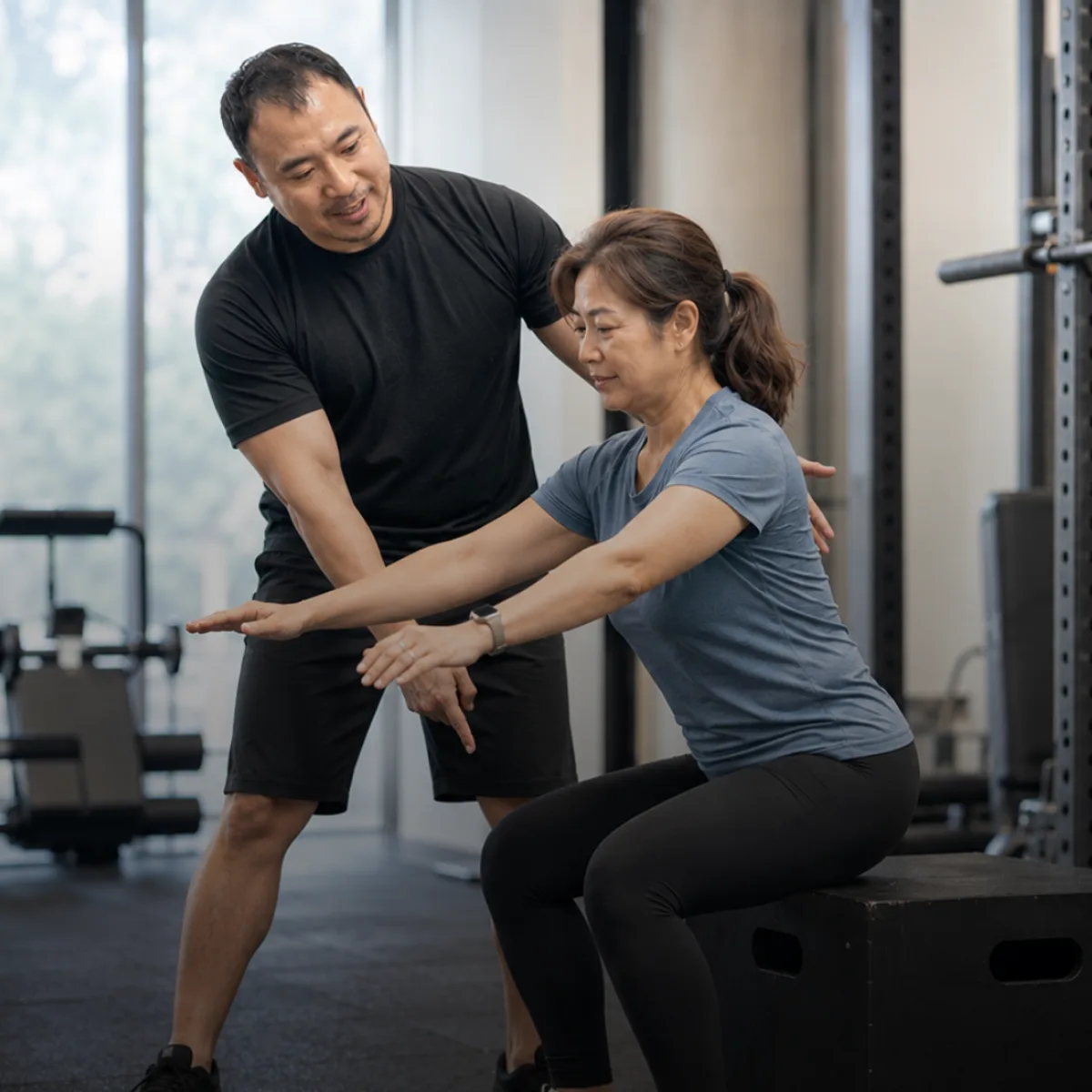
Build strength that supports your real life
Your progress should mean more than completing exercises inside a gym. Depending on your starting point and goals, we may help you work towards:
Climbing stairs with greater confidence
Carrying groceries and luggage more comfortably
Getting up from a chair or the floor more easily
Feeling steadier on your feet
Returning to exercise after physiotherapy or inactivity
Enjoying travel, hiking, golf or recreational activities
Feeling more confident when lifting weights
Maintaining your independence as you get older
Building a consistent routine that fits your life
Feeling more capable in your own body
Appropriately programmed resistance training can support muscle and bone health, balance and day-to-day function. Consistent practice and gradually increased load help you work towards sustaining strength as you age, with confidence in lifting and carrying.
Progress will not be judged only by your weight or appearance.
We will also look at what you can do now that previously felt difficult or uncertain.
Real words from DGG clients
What clients value about training with Chris.
“Coach Chris is truly a gem, especially for women navigating the challenges of perimenopause!”
“What I appreciate most is his patience, professionalism, and genuine commitment to helping women feel stronger, healthier, and more confident in their bodies.”
“He takes the time to understand how your body moves and adjusts the programme accordingly, rather than taking a one-size-fits-all approach.”
“He is by far the best trainer I ever come across. His vast knowledge and experience are truly amazing.”
Your experience matters. So does the evidence.
Survey · n=147 with symptoms
44.2%
reported joint and muscular discomfort
Survey · n=147 with symptoms
43.5%
reported sleep problems
Exercise guideline · HealthHub
2 days/week
muscle-strengthening activity, as a general recommendation
Survey figures are among the 147 of 160 surveyed women who reported at least one moderate-to-very-severe symptom, not all women in Singapore. They do not show that training treats menopause symptoms.
Sources and details
Lulla et al. survey, 2026
In an online, self-selected survey of 160 perimenopausal women aged 40–60 attending Singapore women’s health talks and forums, 147 reported at least one moderate-to-very-severe symptom. Among those 147, 44.2% reported joint and muscular discomfort, 43.5% sleep problems and 39.5% physical or mental exhaustion.
This sample is not representative of all Singapore women. Associations in the survey do not prove that exercise treats these symptoms.
KKH study and guidelines, 2026
On 20 February 2026, KKH announced Singapore’s first Guidelines on Management of the Menopause Transition. A KKH study of 1,461 women aged 45–65 found 70% had moderate-to-severe menopausal symptoms, including reported weight gain, sleep difficulty and joint or muscle aches.
These findings describe the women studied, not the prevalence among all women in Singapore.
HealthHub guideline
Singapore HealthHub recommends muscle-strengthening activity on at least two days each week. Your starting level and progression should still suit your ability and recovery.
This is general activity guidance, not a prescription for treating perimenopause symptoms.
Darn Good Gym provides strength coaching, not medical care or menopause treatment. New, severe or worsening symptoms should be discussed with a healthcare professional.
Many women remain active through walking, work, household responsibilities and caregiving. But staying busy is not always the same as progressively building strength.
Your programme does not need to take over your life. It needs an appropriate challenge, clear progression and enough consistency to help your body become more capable.
You have spent years taking care of everything else
Career. Family. Responsibilities. Other people’s needs.
It is easy for your own physical health to move further down the list.
You may not notice the change at first.
Then stairs begin to feel more tiring. Carrying shopping feels heavier. Getting up from the floor takes more effort. An old knee, back or shoulder problem makes you cautious about exercise.
You may be returning after physiotherapy, time away from exercise or a change in lifestyle. Midlife can be a reason to rethink your training, not a reason to give up.
You know strength training could help, but you may not know:
- Which exercises are appropriate
- How much weight to use
- Whether you are pushing too hard
- Whether you are being too cautious
- How to train around previous pain or injuries
- How to remain consistent when life is already busy
You do not need another random workout.
You need a clear starting point and someone who knows how to help you progress without rushing the process.
Strength coaching that begins with you
You will not be given a standard programme simply because you are a woman over 40.
If you are looking for a personal trainer for women over 40, the important thing is coaching that listens. Strength training during perimenopause should reflect your experience, not assumptions about your age or hormones.
Before training begins, we take time to understand:
- Your current strength and activity level
- Your training history
- Previous pain, injuries or physiotherapy
- Movements that feel difficult or uncertain
- Your work and family responsibilities
- Your recovery and available training time
- How sleep, energy and joint comfort vary for you
- What you want to become capable of doing
- What stopped previous programmes from working
Your programme is built around your current ability — not around what someone your age is supposedly expected to do.
How the DGG process works
- 1
Assess your starting point
We begin with a conversation and an appropriate movement assessment. This helps us understand what you can currently perform with reasonable confidence and control.
- 2
Build control and confidence
You learn fundamental movements such as squatting, stepping, pushing, pulling, lifting and carrying. Each exercise is explained clearly and adjusted when necessary.
- 3
Add strength gradually
As your control and confidence improve, we may progress the training through more resistance, additional repetitions, greater range of movement, less assistance, more challenging exercise variations and increased training volume when appropriate. The aim is not to rush you. It is to continue helping you move forward.
Not sure where to start? Talk it through with Chris first.
Book Your Free Online AssessmentYou do not need to become smaller to make meaningful progress
You may still want to change your body composition, and that can be discussed as part of a wider health goal.
But Darn Good Gym is not built around crash diets, punishing workouts or dramatic short-term transformations.
Your training is not a punishment for what you ate or how your body looks.
It is an opportunity to:
- Build useful strength
- Improve your physical ability
- Develop greater confidence
- Exercise more consistently
- Prepare your body for the years ahead
The number on the scale is only one possible measure.
Being able to carry more, move more confidently and participate more fully in your life matters too.
Your training needs may change after 40
The programme that suited you when you were younger may not suit your life today.
You may now have:
- More work and family responsibilities
- Less predictable sleep and recovery
- A longer history of aches or injuries
- Less confidence after becoming inactive
- Different priorities from appearance or performance
- A greater interest in strength, health and independence
Perimenopause can change how training feels, but not in the same way for everyone.
When sleep, fatigue or joint comfort vary, we may adjust the weight, repetitions, movement range or recovery between sessions. On other days, you may be ready to do more. Not every change after 40 is caused by perimenopause or menopause.
Darn Good Gym does not diagnose or treat menopause-related symptoms.
We consider your current energy, recovery, physical concerns and medical guidance when deciding how your training should be structured.
Your training does not necessarily need to become easier. It needs to become more individual.
This coaching may be right for you if…
- You are a woman in your 40s, 50s or beyond
- You want strength coaching during perimenopause or beyond, with or without symptoms
- You want to become stronger but do not know where to begin
- You have become inactive and want a structured way to return
- You feel nervous or uncomfortable in a typical gym environment
- You are returning after pain, injury or physiotherapy
- You want to improve your strength, balance and confidence
- You have tried random workouts without making meaningful progress
- You want proper coaching rather than simply being told to work harder
- You care more about lasting capability than rapid transformation
- You are ready to make your own physical health a priority
You do not need previous strength-training experience.
You do not need to become fitter before starting.
Finding the appropriate level from which to begin is part of the coaching process.
Calm, personal one-to-one coaching
You will not be expected to perform in front of a large class or keep up with someone younger or more experienced.
Your sessions are personal and structured around you. Your coach will:
- Explain why each exercise has been selected
- Show you how to perform it
- Observe how you move and respond
- Adjust the exercise where necessary
- Help you understand what you are feeling
- Challenge you when you are ready
- Track your progress over time
You will be supported, but you will also be encouraged to take an active role in the process.
The goal is not to make you dependent on a trainer forever. It is to help you become stronger, more confident and more informed about what your body can do.
Why women over 40 choose Darn Good Gym
More than 20 years of coaching experience
Your training is guided by extensive experience working with adults who have different abilities, limitations and starting points.
Assessment before exercise
We do not begin by placing you into a standard workout.
Control before load
You learn to perform movements with suitable control before resistance or difficulty is increased.
Progress based on your capacity
Your age provides context, but it does not define what you are capable of doing.
No pressure to keep up
Your programme is not based on how quickly another client progresses.
No exhaustion for its own sake
Soreness and fatigue are not treated as the main proof that a session was effective.
Clear professional boundaries
Darn Good Gym provides personal training and strength coaching. We do not diagnose medical conditions, provide physiotherapy or replace medical care.
Start with a free 30-minute online assessment with Chris
You do not need to commit to personal training before understanding whether Darn Good Gym is right for you. During your assessment, we will:
- Discuss your goals and current concerns.
- Review your training, activity and relevant health history.
- Understand what has made exercise difficult or inconsistent.
- Talk through a suitable starting point for strength coaching.
- Explain what we would initially prioritise.
- Recommend a suitable next step.
There is no high-intensity workout and no need to prove how fit you are.
You will leave with a clearer understanding of your current starting point and what an appropriate strength-training process could look like.
30 minutes, online. No workout. No obligation. No high-pressure sales pitch. If you continue, coaching takes place one-to-one in person at Jalan Senang, Singapore.
Frequently Asked Questions
Can I start strength training during perimenopause?→
Yes, many women can begin during perimenopause, including those new to strength training. We start with your current ability and consider your sleep, recovery, health history and any medical guidance. Perimenopause does not mean everyone needs the same programme. New, severe or worsening symptoms should be discussed with a healthcare professional before training.
What if my joints feel uncomfortable?→
Tell Chris what you are feeling. We may adjust the exercise, load, range of movement or pace, or stop the exercise when needed. Adapting exercise is not the same as diagnosing or treating joint pain. New, severe, unexplained or worsening symptoms should be assessed by a healthcare professional; do not assume they are caused by perimenopause.
How often should women over 40 strength train?→
HealthHub recommends muscle-strengthening activity on at least two days each week. This is a general goal, not a requirement to start with two hard sessions. Chris will discuss a manageable starting routine, recovery between sessions and gradual progression based on your current capacity and schedule.
I have not exercised for years. Can I still start?→
Yes. Becoming inactive is a common starting point. Your programme will begin according to your current capacity, not according to the level you were at years ago.
Can I train if I have knee, back or shoulder discomfort?→
It depends on the nature of your symptoms and current condition. We will discuss your history and determine what appears appropriate. New, severe, unexplained or worsening symptoms should be assessed by a suitable healthcare professional.
Can I begin after physiotherapy?→
Yes, where you have been cleared to exercise. We can consider relevant recommendations from your physiotherapist while helping you transition towards broader strength training.
Is this a weight-loss programme?→
No. Darn Good Gym is not a rapid weight-loss or body-transformation programme. Body composition can be discussed as part of your wider goals, but the main focus is building strength, confidence and lasting physical capability.
Do you provide menopause treatment?→
No. We do not diagnose or treat menopause symptoms. Training can be adjusted according to your current capacity, recovery and relevant medical guidance, but clinical symptoms should be discussed with an appropriate healthcare professional.
Will every session be very intense?→
No. Your sessions should provide enough challenge to support progress while still allowing you to train with suitable control and recover appropriately. Intensity is one part of training. It is not the only measure of a useful session.
Build strength for the life you want to keep living
You do not need to be the youngest, fittest or most confident person in the gym. You only need an appropriate place to begin.
Your past may explain why you do not feel as strong as you want to today. It does not have to decide what you will be capable of next.
Personal training for women over 40 in Singapore who want to become stronger after pain, physiotherapy, inactivity or years of putting their own health last.